
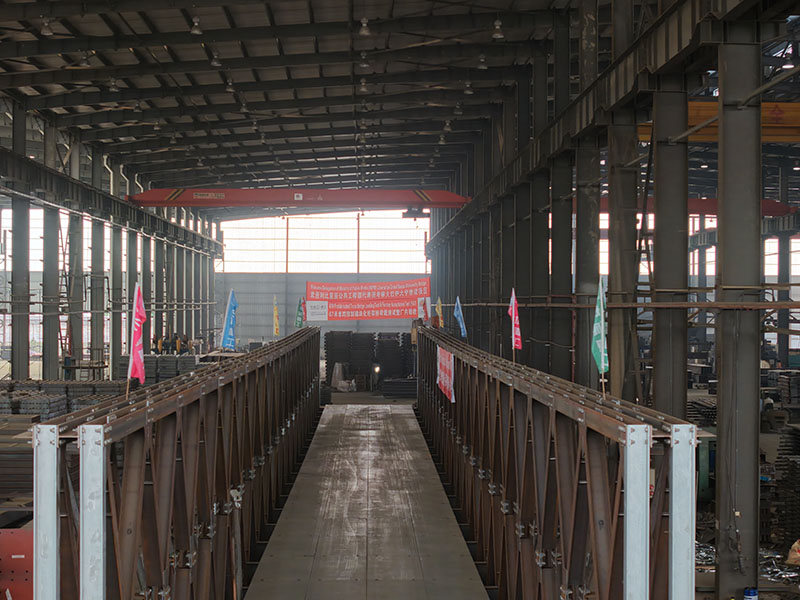
In Indonesian public procurement, the steel arrives after the signatures. A bridge that cannot document itself cannot enter service — no matter how good the welds look. This article walks through the paper trail that accompanies our modular steel bridges, certificate by certificate, so evaluators can see exactly what lands in the bid folder.
1. The design basis: SNI 1725:2016, in writing
Every structure is calculated to SNI 1725:2016 — Indonesia’s bridge loading standard, with the 500 kN “T” truck and the “D” lane load — and seismic effects to SNI 2833 for the project’s ground-motion zone. Because the Indonesian market is explicitly project-specification-driven, we confirm the project design basis in writing before fabrication: code version, load case combinations, material grades, and the client’s own supplements. That single document prevents the most expensive misunderstanding in bridge procurement — discovering, after fabrication, that the design basis assumed was not the design basis issued.
2. The welds: EN 1090-2 EXC3 and EN ISO 9606-1
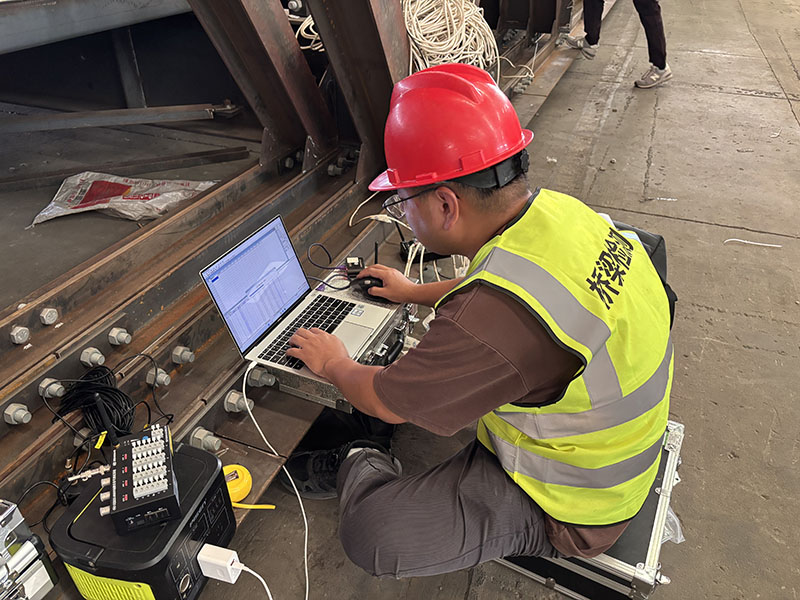
Welding is where bridge quality lives or dies, and it is where we carry formal certification: welding personnel and procedures certified by Bureau Veritas (BV), executed to EN 1090-2 Execution Class EXC3— the class for bridge-grade steelwork — with welders qualified to EN ISO 9606-1. For every fabrication lot: qualified WPS records, magnetic-particle and ultrasonic testing, and photographic archives. If an evaluator wants to see the weld behind the certificate, the file answers before the factory does.
3. The steel: mill certificates and laboratory testing
Every batch of steel arrives with mill test certificates, and our own laboratory re-verifies it: universal tensile testing, low-temperature impact, hardness, and metal spectrometry, on calibrated equipment with current verification certificates. The chain — mill certificate → incoming test → fabrication → finished-product inspection — is continuous and archived per lot.
4. The third party: SGS, CCIC, CNAS
Independent verification of raw materials and finished products by SGS, CCIC and CNAS closes the loop before shipment. Inspection reports — such as the SGS report included in every shipment package — are issued in English and ready for presentation in Bina Marga public bidding and donor-funded procedures, where the evaluator’s first question is always “who checked the checker?”
5. The corrosion protection: ISO 1461
Hot-dip galvanizing to ISO 1461 on structures, pins and fasteners, with dimensional control, zinc-thickness verification and adhesion testing recorded per batch. For coastal, estuarine and industrial corridors, an optional ISO 12944 C4/C5-M duplex system is documented the same way — because in 80% humidity, the coating is not a finish; it is a structural system with its own QA file.
6. The management systems: ISO 9001 / 14001 / 45001
These certify the factory behind the product: quality, environment, occupational health and safety. They tell an evaluator the factory runs on documented procedures, calibration loops and corrective actions — the machinery that makes certificate No. 2 through No. 5 true for every lot, not just the demonstration lot.
7. The shipment package
When the container lands at Tanjung Priok, Tanjung Perak or Belawan, the folder inside it contains: material quality certificates, approved drawings, welding and NDT records, galvanizing reports, third-party inspection reports, erection drawings and the O\&M manual — in English, complete, first time. Demurrage and document disputes are planning failures; our job is to make sure this is not where your project loses its weeks.
Post time: Oct-22-2026