

On 26 September 2026, the Pampatama Bridge in Peru’s Apurímac region failed in a single afternoon. It was the only direct link between the provinces of Aymaraes and Andahuaylas. For Peru’s Ministry of Transport and Communications (MTC), restoring that crossing is now a technology-selection question.
1. What Happened at the Pampatama Bridge
The Pampatama crossing links Aymaraes and Andahuaylas in the southern highlands of Apurímac. It collapsed on a Saturday afternoon, severing a vital economic and social lifeline for the communities on both sides.
According to the MTC, the failure was not caused by age. Witnesses reported that two heavy trucks loaded with mineral cargo entered the bridge at the same time, shortly after 13:00. The bridge could not take the combined weight of two loaded vehicles crossing in tandem. Both trucks went down into the riverbed, and the drivers abandoned their vehicles and left the scene.
The Minister of Transport and Communications set out the sequence plainly in a radio interview: it was “an act of extreme imprudence by the drivers to attempt to cross one truck right behind the other,” and the simultaneous transit “significantly exceeded the bridge’s capacity.”
The collapse also exposed a pattern: mining haulage runs daily on regional bridges never designed for those loads, and weight limits are often ignored.
2. Seven Days Is the Target — the Route Cannot Wait Longer
The MTC moved into emergency mode. With the regional government of Apurímac, the Ministry agreed on an intervention plan: a modular bridge standing about 51 km from the collapse site will be dismantled, transported across rugged Andean terrain, and reassembled by Provías Descentralizado. The published target for restoring transit is seven days, after which a permanent structural solution will be engineered.
Until the replacement span is in place, communities on both sides remain in a state of suspended transit. Mineral haulage stops or detours, and so do agricultural produce, fuel, school transport and ambulance runs. In the highlands a detour is never small — it is hours of switchbacks on roads not built for heavy traffic, and every hour carries a freight cost.
The lesson is simple: when a crossing is lost, the recovery method decides the recovery time. Concrete replacement is measured in months; a prefabricated modular steel bridge is measured in days.
3. Why a Modular Steel Bailey Bridge Fits Andean Terrain and Mine Traffic
A Bailey bridge is a prefabricated modular steel truss bridge. Standardized panels, transoms and bracing are trucked to site and assembled into a working span. In conditions like Apurímac’s, four characteristics matter most.
- Every component travels as a standard truck load; every connection is a pin. → No site welding, no certified welders, no heavy crane. Ordinary crews with hand tools can erect the span, cutting both cost and risk on a remote site.
- Cantilever launching, no intermediate piers. → The span is pushed across from one bank, so nothing sits in the floodway. Poor riverbeds and deep water stop being design blockers.
- Standard single spans of 12–60 m; the Type D configuration reaches 91 m. → One long span can replace several piers and their foundations, which cuts substructure cost and construction time.
- The design load is set by the client. Nominal ratings are HL-93, HS20-44 or HS25-44, extendable to 50 t, 80 t, 100 t or more, anchored to the local legal axle limit. → The bridge is engineered around the traffic you actually run.
Two more numbers matter. Deflection is limited to L/800 and fatigue is verified over 1,000,000 cycles, so heavy traffic does not leave a sagging deck. All steel is hot-dip galvanized for wet highland conditions. And the system is demountable: when the permanent bridge opens, the span can be recovered and launched at the next failed crossing — an asset, not a sunk cost.
4. Built to the Standards Peru Actually Tenders Under
Peru’s Manual de Puentes (MTC, 2018) is built on AASHTO LRFD, and the HL-93 design truck is the reference live load for Peruvian highway bridges. Our modular bridges are designed and calculated on the same basis.
- Design and calculation: AASHTO LRFD
- Welding: AWS D1.5, with welding procedures certified by Bureau Veritas
- Corrosion protection: hot-dip galvanizing to ASTM A123/A153 (ISO 1461 equivalent)
- Third-party inspection: SGS, CCIC, CNAS
- Management systems: ISO 9001, ISO 14001, ISO 45001
For a road authority: shop drawings, weld documents and inspection reports arrive in the format the MTC and its supervising engineers already use. Compliance will not delay the opening date.
5. Already Delivered: A 40 m Bailey Bridge Completed in Ethiopia
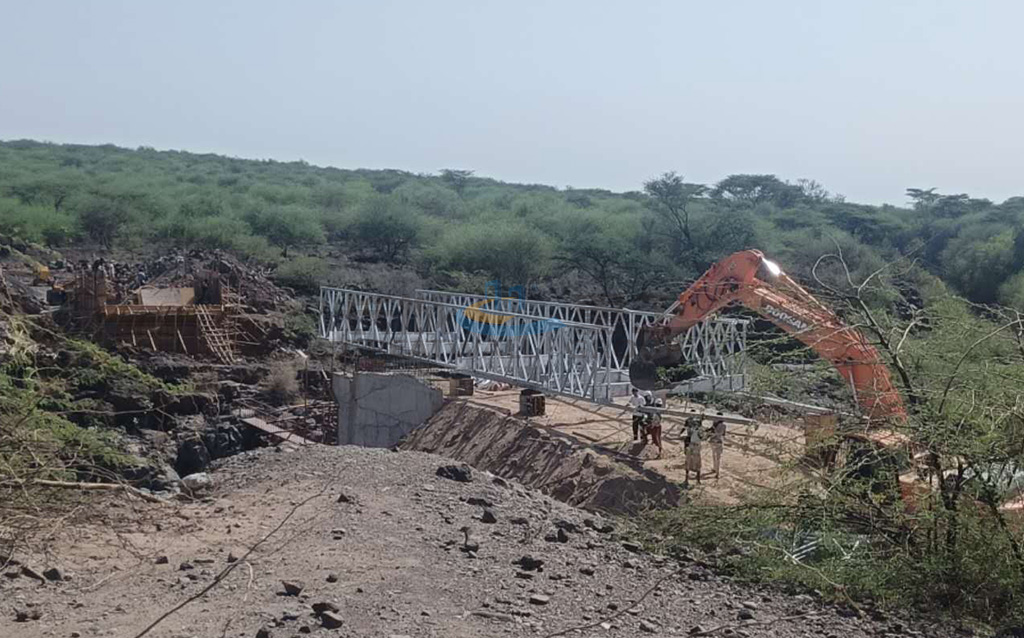
This is not a theoretical proposal. In August 2025 our team completed another 40 m Bailey bridge in Ethiopia. Before it opened, residents took long detours or crossed rivers by unsafe means. Once in service, travel time between communities fell, school and clinic trips became routine, and the cost of moving produce to market dropped. Families cut off by a river could visit again.
Ethiopia and Apurímac share the same problem: remote terrain, limited heavy equipment, and communities that cannot wait a year. The span there was delivered as a prefabricated modular steel truss bridge — standardized components, fast assembly, transportable to difficult-access sites, durable in harsh conditions.
That project sits inside a track record of more than 500 bridges in 30+ countries on four continents, from an annual production capacity of 10,000 tonnes. Apurímac would get a proven, mass-produced system, not an experiment.
6. A Local Partner, Not Just a Steel Supplier
A road authority is not buying steel. It is buying restored access today and capability for tomorrow. Every project can include training for local crews, on-site supervision during assembly, and full technology transfer, so your engineers learn to launch, inspect and redeploy the system themselves. The next closed crossing should not depend on an erection crew arriving from another continent.
7. Questions We Get Asked by Road Authorities
Q: How fast can a replacement span be on site and open to traffic?
A: An emergency assembly crew can be deployed within 24–72 hours of an order. Panels and transoms ship as standard truck loads and are erected with hand tools. On a site like Pampatama, the critical path is the last few kilometres of transport, not the bridge.
Q: Our corridor runs 80–100 t mining trucks. Can a modular steel bridge take that?
A: Yes. We do not offer one fixed bridge type; we design to the axle load you nominate and anchor the calculation to the local legal limit — nominally HL-93, and upward to 50 t, 80 t, 100 t or more. Every design is verified with an AASHTO LRFD calculation, an L/800 deflection limit and a 1,000,000-cycle fatigue check.
Q: If a permanent bridge is built later, is the temporary span wasted money?
A: No. Bailey bridges are demountable. The same span can be recovered, trucked and launched at the next failed crossing, or held as regional emergency stock. A concrete replacement cannot be recovered and reused.
Sources
ADERS-Peru, 27 Sep 2026 — https://aders-peru.org/infrastructure-crisis-in-apurimac-minister-tangherlini-addresses-bridge-collapse-and-national-political-friction
华人头条 (52hrtt), 26 Sep 2026 — https://www.52hrtt.com/za/n/w/info/D1789959626328
Great Wall Group, 1 Aug 2025 — https://www.greatwallgroup.net/news/congratulations-on-the-completion-of-another-40m-bailey-bridge-of-our-company-in-ethiopia/
Post time: Oct-14-2026