

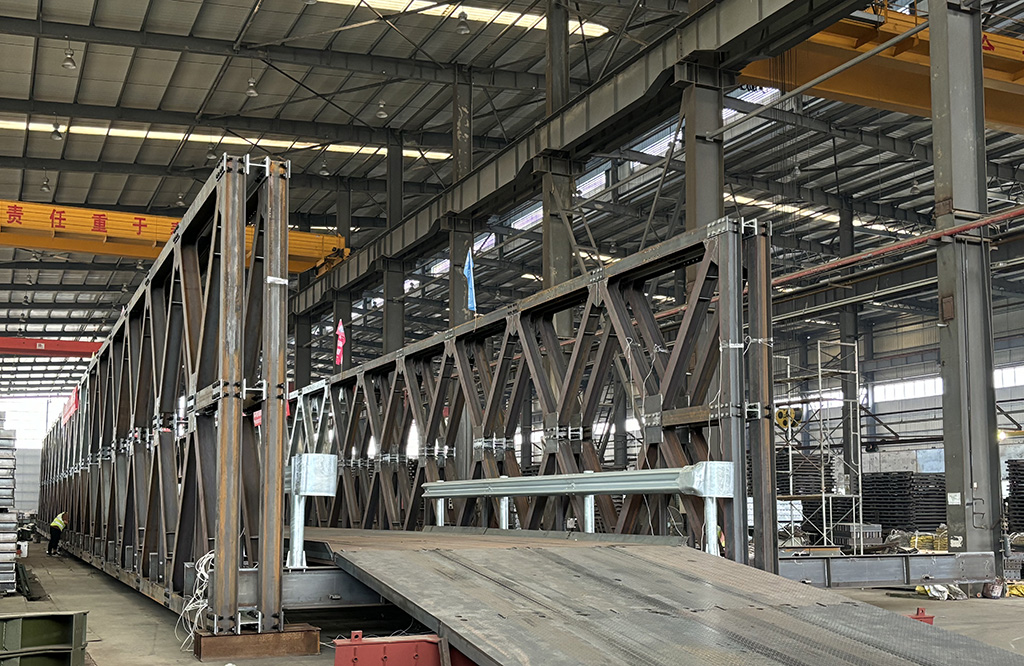
Great Wall leads the industry in modular bridge manufacturing. The 67m D type C3DDR modular prefabricated bridge demonstrates advanced engineering with rapid assembly and outstanding durability. Heavy-duty applications benefit from its robust design and modular system. The 67m D type C3DDR modular prefabricated bridge offers reliable solutions for challenging environments, making it ideal for infrastructure projects in regions such as Liberia.
Key Takeaways
- The 67m D type C3DDR bridge features a modular design that allows for quick assembly and disassembly, making it ideal for both temporary and permanent installations.
- High-strength steel components ensure the bridge can handle heavy loads while maintaining durability and resistance to deformation.
- The bridge complies with international standards, ensuring reliable performance and safety in various environments and under different load conditions.
- Routine maintenance, including inspections and protective coating renewal, is essential for extending the bridge’s service life and ensuring user safety.
- Great Wall’s modular bridge system offers flexibility in design, allowing customization to meet specific project needs and site conditions.
Design and Structure
67m D type C3DDR modular prefabricated bridge overview
The 67m D type C3DDR modular prefabricated bridge represents a significant advancement in modular bridge engineering. Great Wall applies rigorous engineering standards to every stage of design and production. The D type configuration features a robust truss system that optimizes load distribution and enhances overall stability. The C3DDR modular system allows for efficient assembly and disassembly, making it suitable for both temporary and permanent installations. This bridge type supports heavy-duty applications and adapts to a wide range of infrastructure needs. The modular design ensures that each component fits precisely, reducing construction time and minimizing on-site adjustments.
Modular span and configuration
The modular span system of the 67m D type C3DDR modular prefabricated bridge provides exceptional versatility. Each module is prefabricated under controlled factory conditions, ensuring consistent quality and dimensional accuracy. The bridge can be configured in multiple span arrangements, allowing engineers to tailor the structure to specific project requirements. The modular system adapts to varying terrain and infrastructure demands. The following table outlines key features that support this adaptability:
|
Feature |
Description |
|
Flexibility |
The system allows for adjustments in dimensions and load capacities, accommodating various geometries. |
|
Height Capability |
Type-tested for heights up to 21.89 m, with the option to add frames for increased height. |
|
Load Adaptability |
Capable of transferring both high load concentrations and small area loads effectively. |
|
Rigidity |
High rigidity of ledger connections ensures stability during movement and assembly. |
|
Compatibility |
Works in coordination with PERI formwork systems for optimized load transfer. |
|
Assembly Efficiency |
Units can be pre-assembled and easily connected to form large shoring structures. |
|
Geometric Adaptation |
Can be adjusted to fit complex shapes with minimal effort using standard materials. |
This modular approach streamlines logistics and enables rapid deployment, which is essential for emergency response and infrastructure upgrades.
Flexibility for different sites
The 67m D type C3DDR modular prefabricated bridge offers outstanding flexibility for diverse site conditions. Structural steel components provide freedom and versatility to meet a wide range of architectural requirements. The high strength-to-weight ratio allows for open and spacious bridge interiors, while slender and elegant structural elements enhance both function and aesthetics. The design supports the integration of architectural features such as cantilevers and arches. Extensive customization and fabrication options enable the bridge to address unique project challenges. Prefabricated modular units facilitate faster assembly and allow for easy modifications on site.
Tip: The modular system of the 67m D type C3DDR modular prefabricated bridge enables project teams to respond quickly to changing site conditions, reducing downtime and ensuring project continuity.
Great Wall’s commitment to innovation and quality ensures that each bridge delivers reliable performance, regardless of location or environmental challenges.
Materials and Durability
High-strength steel components
The 67m D type C3DDR modular prefabricated bridge uses high-strength steel for all major structural elements. This material choice ensures the bridge can handle heavy loads and resist deformation under stress. High-strength steel offers a superior strength-to-weight ratio, which allows for longer spans and lighter components. Engineers select steel grades that meet international standards for durability and performance. The use of advanced steel fabrication techniques results in precise, uniform parts that fit together seamlessly. This approach not only increases the bridge’s load-bearing capacity but also extends its service life.
Corrosion resistance
Corrosion resistance is a critical factor in the longevity of any steel bridge. The 67m D type C3DDR modular prefabricated bridge incorporates several protective measures to guard against rust and environmental damage:
Corrosion-resistant coatings such as galvanizing or specialized paints are applied to all steel surfaces.
Stainless steel alloys are used in areas exposed to the most severe conditions.
Protective barriers prevent direct contact between steel and corrosive elements.
Regular maintenance routines help preserve the integrity of these coatings, especially in harsh environments.
Note: These measures ensure the bridge remains structurally sound and visually appealing over many years of service.
Prefabrication quality
Great Wall maintains strict quality control throughout the prefabrication process. Each stage of manufacturing undergoes comprehensive inspections to detect any defects early. The company employs non-destructive testing methods, including radiographic, magnetic particle, and ultrasonic testing, to verify the integrity of steel components. Before shipping, every bridge section receives a final inspection to confirm it meets all specifications.
|
Quality Control Measure |
Description |
|
Comprehensive Inspections |
Every stage of the manufacturing process is subject to quality tests. |
|
Non-Destructive Testing Methods |
Includes radiographic, magnetic particle, and ultrasonic testing. |
|
Final Inspection Before Shipping |
Ensures that only faultless and dependable items leave the production site. |
These rigorous procedures guarantee that each 67m D type C3DDR modular prefabricated bridge delivers consistent quality and long-term durability.
Load Capacity and Performance
Heavy-duty applications
The 67m D type C3DDR modular prefabricated bridge stands out in heavy-duty scenarios. Its design supports the movement of large vehicles, including trucks and construction equipment. Engineers select high-strength steel and advanced truss configurations to ensure the bridge can handle concentrated loads. The modular system allows for the distribution of weight across multiple points, reducing stress on any single component.
Key features for heavy-duty use include:
Optimized truss geometry: Distributes loads efficiently, minimizing deflection.
Reinforced deck panels: Withstand repeated impact from heavy traffic.
Robust connections: Secure each module, preventing movement under dynamic loads.
Note: This bridge type is suitable for both temporary and permanent installations in demanding environments, such as mining sites, industrial zones, and major transportation corridors.
Safety and stability
Safety remains a top priority in the design of the 67m D type C3DDR modular prefabricated bridge. The structure incorporates multiple safety features to protect users and maintain stability under all conditions. Engineers use redundant load paths, which means that if one component fails, others will continue to support the bridge. This approach reduces the risk of sudden collapse.
The bridge also includes:
Anti-slip surfaces: Improve traction for vehicles and pedestrians.
Guardrails and barriers: Prevent accidental falls and enhance user safety.
Vibration dampening systems: Reduce oscillations caused by wind or moving loads.
A table below summarizes the main safety and stability features:
|
Feature |
Benefit |
|
Redundant load paths |
Maintains structural integrity if damaged |
|
Anti-slip surfaces |
Reduces accident risk |
|
Guardrails/barriers |
Enhances user protection |
|
Vibration dampening |
Increases comfort and structural stability |
Tip: Regular inspections and maintenance further enhance the safety and reliability of the bridge throughout its service life.
International standards compliance
Great Wall ensures that every bridge meets or exceeds international standards. The 67m D type C3DDR modular prefabricated bridge complies with recognized codes such as AS5100, AASHTO, and EN standards. These certifications guarantee that the bridge performs reliably in diverse environments and under various load conditions.
Compliance highlights:
AS5100 (Australia): Ensures structural adequacy for road bridges.
AASHTO (USA): Sets guidelines for highway bridge design and safety.
EN standards (Europe): Covers performance, durability, and safety requirements.
Compliance with these standards demonstrates Great Wall’s commitment to quality and global best practices. Project owners can trust that the bridge will deliver consistent performance, regardless of location.
Installation and Maintenance
Rapid assembly process
The 67m D type C3DDR modular prefabricated bridge features a rapid assembly process. Great Wall engineers design each module for intuitive connection. Workers can assemble the bridge on-site without specialized skills. The prefabricated components arrive ready for installation, which reduces preparation time. Teams follow a step-by-step sequence that ensures accuracy and safety at every stage.
Tip: The modular system allows for parallel assembly of sections, which speeds up the overall construction timeline.
Great Wall’s project management team coordinates logistics to ensure timely delivery of all parts. This approach minimizes delays and supports on-schedule project completion, even in remote or challenging environments.
Minimal equipment required
The installation of the 67m D type C3DDR modular prefabricated bridge requires minimal heavy equipment. Most assembly tasks use standard tools and light machinery. Cranes or lifting devices handle larger modules, but the bridge’s modular design reduces the need for oversized equipment.
Key equipment typically includes:
Mobile cranes (for lifting main modules)
Hand tools (for bolting and alignment)
Light-duty vehicles (for transporting components on-site)
This streamlined equipment requirement lowers transportation costs and simplifies logistics. It also enables installation in areas with limited infrastructure or access.
Maintenance guidelines
Routine maintenance ensures the long-term performance of the bridge. Great Wall provides clear guidelines for inspection and upkeep. Maintenance teams should focus on the following:
|
Task |
Frequency |
Purpose |
|
Visual inspections |
Monthly |
Detect surface wear or damage |
|
Bolt and joint checks |
Quarterly |
Ensure structural connections remain tight |
|
Surface cleaning |
As needed |
Remove debris and prevent corrosion |
|
Protective coating renewal |
Every 2-3 years |
Maintain corrosion resistance |
Note: Following these guidelines helps extend the service life of the bridge and maintains safety for all users.
Great Wall’s extensive experience in modular bridge projects ensures that clients receive ongoing support and technical expertise throughout the bridge’s lifecycle.
The 67m D type C3DDR modular prefabricated bridge delivers robust performance and adaptability for infrastructure projects. Great Wall’s Bailey Bridges offer key advantages:
Time efficiency: Prefabrication reduces project timelines by half.
Reusability: Modular units can be redeveloped or repurposed.
Safety: Controlled manufacturing enhances worker safety.
Environmental benefits: Material savings and reduced waste.
Design flexibility: Solutions fit a range of budgets and requirements.
Decision-makers seeking reliable and efficient bridge solutions will find Great Wall’s modular systems a proven choice.
FAQ
What is the typical installation time for the 67m D type C3DDR modular prefabricated bridge?
Installation usually takes less than two weeks. Prefabricated modules arrive ready for assembly. Teams follow a streamlined process. Minimal equipment is required. Great Wall’s project management ensures efficient scheduling.
Can the bridge be customized for different site conditions?
Yes. The modular design allows for adjustments in span, height, and load capacity. Engineers can tailor the bridge to fit unique terrain and project requirements. Custom fabrication options are available.
What maintenance is required to ensure long-term durability?
Routine inspections, bolt checks, surface cleaning, and protective coating renewal are recommended. Maintenance teams follow Great Wall’s guidelines. These steps help preserve structural integrity and extend service life.
Does the bridge meet international standards?
The 67m D type C3DDR modular prefabricated bridge complies with AS5100, AASHTO, and EN standards. These certifications guarantee reliable performance and safety in global infrastructure projects.
Is the bridge suitable for heavy traffic and emergency use?
| Application | Suitability |
| Heavy vehicles | Excellent |
| Emergency response | Highly effective |
The bridge supports heavy-duty vehicles and rapid deployment in emergencies. Prefabricated modules enable quick assembly.
Post time: Jun-01-2026